BJT Business Japanese Proficiency Test
The second year of college has ended, and I'm currently spending the summer in Korea. Compared to freshman year, my sophomore year offered more opportunities for learning and growth. As an international student in the U.S., I often feel that I must build exceptional skills. One of them was to improve my multilingual proficiency.
I can speak Korean, English, Mandarin Chinese, and Japanese, but I didn't have an official certification in Japanese, so I decided to study it.
I never formally studied Japanese through classes or textbooks, but learned it naturally through my hobbies, especially anime and baseball. When my favorite baseball player, Seunghwan Oh, moved to the Hanshin Tigers in Japan, I started watching the Japanese baseball league. Through games and documentaries, I became familiar with the language.
I met many Japanese friends while I was studying in China since the 9th grade. We communicated in Japanese, and they helped me adjust to my new life. Meanwhile, I became familiar with Kanji while studying Chinese characters. These experiences allowed me to learn Japanese naturally. Even in college, I met a Japanese upperclassman. Although he already graduated, we're still good friends. After my military service, I briefly interned at a Japanese marketing agency in Seoul, South Korea, where I first used Japanese in a professional setting.
Since I've never lived in Japan, I wanted to prove to myself that I can speak Japanese fluently. Initially, I planned to take the Japanese-Language Proficiency Test (JLPT). However, I missed the application deadline. Instead, I chose the BJT Business Japanese Proficiency Test (BJT) because it has more flexible scheduling compared to the JLPT. BJT is generally considered more challenging than the JLPT because it tests both language and business communication skills.
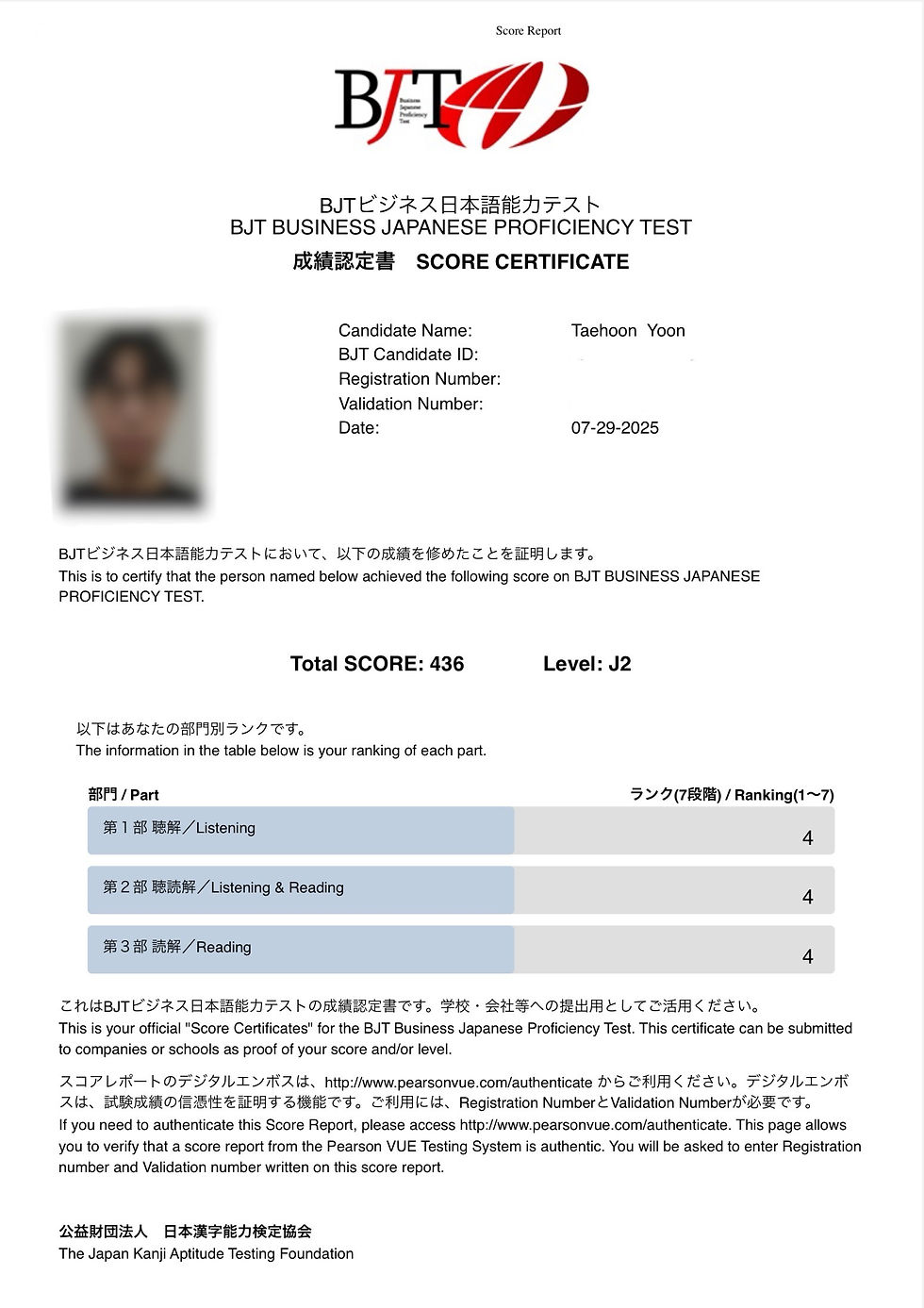
Summer vacation allowed me to fully focus on studying for the test. The test has no pass or fail system, but ranks a candidate's proficiency with levels from J5 (the lowest) to J1+ (the highest). I achieved a J2 level with a score of 436 out of 800 points. My original goal was 480. I didn't reach that score, however, J2 is still a result I'm proud of.
After the test, J.P. Morgan sent me an invitation to attend a networking event in Tokyo. I'll be attending next week. This summer vacation has flown filled with meaningful experiences. Although I didn't intern this summer, it was a great opportunity to be a better person than yesterday.
I can confidently introduce myself as a college student fluent in four languages. This will be a cornerstone leading me to step into the global business world. Little drops of water make a mighty ocean. What will I do next summer and by the time I graduate in May 2027?